


—
Today Hank talks about your central nervous system. In this episode we’ll explore how your brain develops and how important location is for each of your brain’s many functions.
—
—
Transcript Provided by YouTube:
00:00
James was healthy professional, a father of two. He had lots of friends, loved telling
00:04
jokes, and played softball on Sundays.
00:06
Then one day, at the age of 45, he suffered a stroke. He bounced back fairly quickly,
00:10
with one major exception: He was no longer able to speak. The stroke damaged a specific
00:15
area in the left hemisphere of his brain called Broca’s area, and left him with what’s
00:20
known as Broca’s aphasia.
00:22
Broca’s area is partly responsible for the ability to produce and process language, and
00:26
Broca’s aphasia often leaves its sufferers with some ability to understand speech, but
00:31
an inability to produce intelligible words.
00:33
James could understand his wife when she asked if he wanted cereal for breakfast, but he
00:37
could only respond by repeating the word “too” — although he could still intonate as though
00:42
he were speaking a whole sentence.
00:43
Then, after some time and therapy, something rather unexpected happened — James regained
00:48
some ability to communicate through singing.
00:51
Broca’s aphasia can sometimes be treated by teaching patients to sing, because singing
00:55
uses a different region of the brain — one that’s on the right side and that’s analogous
01:00
to Broca’s area on the left.
01:01
So after some practice, James could sing words, and he eventually relearned how to talk by
01:06
teaching the right side of his brain to speak rather than sing.
01:10
Whether it’s a stroke affecting your speech, a tumor destroying your memory, a concussion
01:13
affecting your aggression, or that fateful iron rod that shot straight through Phineas Gage’s
01:18
skull — a lot of what we know about how the brain works has come through studying injuries to it.
01:23
And what we’ve learned so far is that, even though it looks like a 1.4-kilogram lump of
01:27
gray, congealed oatmeal, the brain is made up of super-specific areas that have super-specific functions.
01:33
You might actually say the same thing about your brain that’s sometimes said about politics:
01:37
Everything is local.
01:48
You’ll remember that our nervous system is divided into two main networks that work
01:52
in harmony — the central nervous system, consisting of your amazing brain and spinal
01:56
cord, and the peripheral nervous system, made up of the nerves coming out of that central nervous system.
02:01
The central nervous system’s main game is integrating the sensory information that the
02:04
peripheral system collects from all over the body, and responding to it by coordinating
02:09
both conscious and unconscious activity.
02:11
The sun is bright, so I’ll shade my eyes; I’m hungry, so I’m calling the pizza man;
02:15
the phone is ringing, maybe I’ll answer it.
02:17
All these sensations, thoughts, and directions process through this two-part system.
02:21
It’s the brain, of course, that sorts out all that sensory information and gives orders.
02:25
It also carries out your most complex functions, like thinking, and feeling, and remembering.
02:30
Meanwhile, your spinal cord conducts two-way signals between your brain and the rest of
02:33
your body, while also governing basic muscle reflexes and patterns that don’t need your
02:38
brain’s blessing to work — this is how a chicken can still run around even if the
02:42
poor thing has been decapitated.
02:43
Both your spinal cord and brain are made of fragile, jelly-like nervous tissue that is
02:48
extremely susceptible to injury.
02:50
So all that goo is well-protected by the bones of your vertebrae and cranium, as well as
02:54
membrane layers, or meninges, before being bathed in a cushy waterbed of clear cerebrospinal fluid.
03:00
This fluid actually allows your brain to float somewhat in your skull, reducing its weight
03:04
and letting it slosh around while you and your head are free to move.
03:07
But even with all that extra protection, your brain is still vulnerable. And one thing James’s
03:12
story taught us is that its vulnerabilities can be incredibly specific, because your brain
03:16
is divided into specialized regions that may, or may not, interact with each other to produce a given action.
03:21
We can better understand this division of labor by looking at how the brain first develops
03:25
into its main component parts.
03:27
Inside a developing embryo, the central nervous system starts off as a humble little neural tube.
03:32
Soon the caudal, or lower, end of the tube stretches out, forming the spinal cord, while
03:37
the cranial end begins to expand, divide, and enlarge into three primary brain vesicles,
03:43
or interconnected chambers.
03:44
This is kind of your proto-brain.
03:46
We call these chambers the prosencephalon, the mesencephalon, and the rhombencephalon
03:51
— or forebrain, midbrain, and hindbrain.
03:54
By an embryo’s fifth week of development, these main three chambers start morphing into
03:58
five secondary vesicles that essentially form the roots of what will become your grown-up brain structures.
04:04
The prosencephalon divides into two sections — the telencephalon and the diencephalon.
04:08
The rhombencephalon forms into another pair, called the metencephalon and the myelencephalon.
04:13
And in between, the mesencephalon, thanks to evolution, remains undivided.
04:17
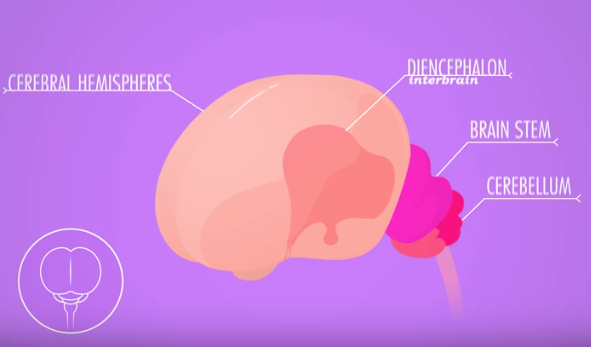
The real action starts as these five secondary vesicles start developing into the major adult
04:22
brain regions that you might be more familiar with — the brainstem, the cerebellum, the
04:26
diencephalon, also known as the interbrain, and finally the cerebral hemispheres.
04:31
But, in order to go from a simple tube into that classic, wrinkly icon we think of as
04:35
the “brain,” each of these five vesicles grows in different ways. Basically, some develop
04:41
a lot more than others.
04:42
The least dramatic changes occur in the three most caudal or lower sections: the mesencephalon,
04:47
the metencephalon, and the myelencephalon.
04:50
They go on to form the cerebellum, which mostly helps coordinate muscular activity, and the brainstem,
04:55
which plays a vital role in relaying information between the body and the higher regions of the brain.
05:00
The brainstem actually has three main components — and I know this is getting to be a lot
05:04
of vocabulary here — you have the midbrain, the pons, and the medulla oblongata. Together
05:08
they regulate many of the most basic, vital involuntary functions, like keeping your heart on pace, keeping
05:13
your lungs working, and controlling things like sleep, and appetite, and pain sensitivity, and awareness.
05:17
But of the three brainstem parts, it’s your midbrain that carries out the higher-level functions.
05:22
Like, when your eyes track a fast moving object, or when you look behind you after hearing
05:26
some sudden loud sound, it’s the midbrain that receives and processes that sensory information
05:31
and sends out the reflexive motor signals, so you react without thinking.
05:34
The midbrain also passes that data to regions like the cerebral cortex, which do the actual
05:39
conscious thinking about the stimuli, like “What is that thing whizzing across the sky?”
05:43
or “WHAT JUST EXPLODED BEHIND ME?!”
05:45
So with the brainstem and cerebellum covering your basic life and motor functions, you start
05:49
to see somewhat more complex tasks being carried out in the next major brain structure, the diencephalon.
05:54
This is where you find the thalamus, hypothalamus, epithalamus, and the mammillary bodies, which
05:59
regulate things like homeostasis, alertness, and reproductive activity. Here we also find
06:04
part of the limbic system, which is a center for strong emotions, like fear.
06:08
This area is sometimes called the “reptilian brain” because we share it with some of
06:11
our less philosophical animal brethren like lizards and fish.
06:14
I’m not putting these guys down, but by our standards, they don’t think so much
06:18
as focus on the more instinctual pursuits that are ruled by the caudal regions of the
06:22
brain — eat, drink, sleep, mate, stay safe.
06:26
All those things are awesome. But it wasn’t until the appearance of birds and mammals
06:30
that some animals’ brains came to be dominated by the last of the five vesicles, the telencephalon.
06:35
During your brain’s growth, the telencephalon undergoes the biggest changes of all, as it
06:40
develops into the most brainy part of your brain — the two classic, walnut-looking hemispheres
06:45
we collectively call the cerebrum, that cover the rest of your brain like a mushroom cap on its stalk.
06:50
That’s the cerebrum — not to be confused with Cerebro, which is Professor X’s telepathy-enhancing
06:55
device — and it is the largest region of the brain and performs the highest functions.
06:59
It’s made up of the wrinkled, outer layer of “gray matter” called the cerebral cortex,
07:04
and the inner squishy layer of “white matter” beneath it.
07:07
And it’s the cerebrum that rules our voluntary movements and our most advanced tricks, like thinking,
07:11
and learning, and regulating and recognizing emotions, and experiencing consciousness in general.
07:16
You’ll remember that higher processing requires lots of synapses, which require lots of nervous tissue.
07:21
So as the cerebrum grew through evolutionary time, it got more massive but our skull didn’t exactly keep up.
07:27
So in order to squeeze all that material into your skull, the brain forms little creases,
07:31
called gyri, and larger grooves, or sulci, giving it more folds than than an origami pineapple.
07:36
And although a big fissure separates the left and right hemispheres, the two halves communicate,
07:41
through a series of myelinated axon fibers called the corpus callosum.
07:45
And each hemisphere has other, smaller fissures that divide it into lobes — each with a different
07:49
set of major functions.
07:50
The frontal lobe, for example, governs muscle control and cognitive functions like planning
07:55
for the future, concentration, and preventing socially unacceptable behaviors.
07:58
In most people, this area doesn’t finish developing until after the teenage years,
08:02
which tells you a lot about the teenage years. Since Broca’s area lives in this lobe in
08:07
the left hemisphere, it also is important in language comprehension and speech.
08:11
If you’re enjoying a beautiful sunset, you can thank your occipital lobe at the back
08:14
of your head for processing those bright visual cues.
08:17
And the next time you step on a lego, you can curse your parietal lobe, which processes
08:22
the sensations of touch, pain, and pressure.
08:25
Meanwhile the temporal lobe helps sort out auditory information, including language.
08:29
It contains Wernicke’s area — another important region of the brain associated with the production
08:34
of written and spoken language.
08:36
This part of the limbic system includes your short-term memory keeper, the hippocampus,
08:40
and the emotional amygdala, which controls sexual and social behavior. So, if you damage
08:44
the wrong part of your temporal lobe, you may never again be able to remember what you
08:48
ate for lunch… or you might suddenly become a total jerk who kicks kittens and cuts in line.
08:52
We could do a whole course on the finer-grained functions and consequences of malfunction
08:56
in every bit of brain in your gourd, but, well, we can’t do that today.
09:00
And you got to remember that, when it comes to your body, no organ or system is an island.
09:04
Your brain would be pretty useless if it weren’t hooked up to the outside world. That’s where
09:08
the peripheral nervous system comes in, which we’ll be spending the next few lessons exploring.
09:12
Meanwhile, you learned today about the central nervous system and how important location
09:16
is to brain function. We looked at how the brain develops from an unassuming neural tube
09:20
into three primary vesicles, and then five secondary vesicles, and finally into our complex
09:25
set of four adult structures and their basic functions.
09:29
Crash Course is now on Patreon! Thank you so much to all of our supporters on Patreon
09:34
who help make Crash Course possible for themselves and for everyone else in the world through their
09:38
monthly contributions. If you like Crash Course and you want to help us keep making great new videos like this
09:43
one, you can check out Patreon.com/CrashCourse
09:46
This episode was written by Kathleen Yale. The script was edited by Blake de Pastino,
09:50
and our consultant, is Dr. Brandon Jackson. It was directed by Nicholas Jenkins and Michael
09:54
Aranda, and our graphics team is Thought Café.
—
Previously published on YouTube.
—
Photo credit: Screenshot from video


.