



Part 5: Taking context into account is a central capacity for understanding the ups and downs of our relationships.
From our book, The Relational Book for Parenting.
“Considering context invites us to track stories, events, and ideas around us that impact the meaning of what we are experiencing. Contexts can be emotional, familial, social, cultural, historical, situational, geographical and more.
Imagine a conversation taking place in two different situations about a challenge a couple is having in their relationship. Scenario one, a couple has just finished receiving one-hour massages at a spa. Scenario two, the same couple has just battled their way through holiday shopping crowds for six hours. In which scenario do you think the couple will have a more generative conversation about their challenge? If you said scenario one or are thinking “it depends,” both acknowledge context.
Clearly, context can be thought of as present events that affect our tone, mood, level of energy and more. But context is also our histories, our fears and the cycle of events we are creating. In order to consider context, we must consider how the multitude of events and experiences we encounter daily intersect. It is a cycle of meaning by which context defines our goals or actions, which in turn, redefine context and so on.”
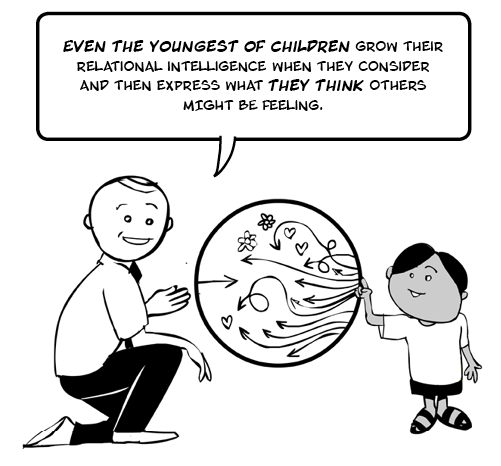
Our children have the capacity to consider the circumstances that inform others’ actions.
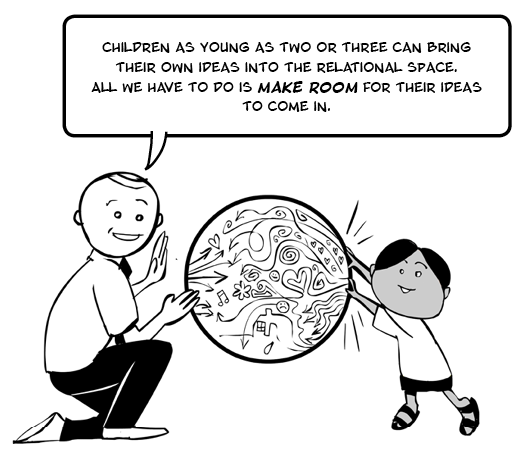
Asking our young children to consider what others might be feeling is a basic but profound introduction to context. When we say, “maybe Sarah had a bad day at school” or “maybe Robby isn’t feeling very confident about sports” we are suggesting that other influences may be informing events that impact us. When we ask our little ones to consider what another child might be feeling, we grow our children’s relational capacity to track and consider the larger context in which our relationships are embedded.
Here are some more comic panels from our book:
—
Please note: this article is not intended to be a replacement for professional care. If you think you need professional help, seek it out.
The Relational Book for Parenting, Part 1: Where Are Our Feelings Created?
The Relational Book for Parenting, Part 2: Labeling Our Emotions
The Relational Book for Parenting, Part 3: Witnessing Our Children’s Difficult Emotions
The Relational Book for Parenting, Part 4: We Live the Stories We Tell
The Relational Book for Parenting, Part 5: Tracking the Powerful Influence of Context
The Relational Book for Parenting, Part 6: Why Is Play The Answer for Businesses and Families Alike?
If this article is helpful, please consider sharing it! Want to learn more about our book? Come to http://ThinkPlayPartners.com And thanks!
Here’s a two minute video on the Relational Book for Parenting. Get a copy of our book at Amazon.com.
The Relational Book for Parenting from ThinkPlay Partners on Vimeo.


.