



I want to welcome you to a new philosophy of life, the first new philosophy of life to appear in a very long time. The philosophy is called kirism, those who identify with it call themselves kirists, and in this first post I want to introduce it to you and explain why you might want to embrace it.

Starting in the seventeenth century, we experienced four hundred years of the celebration—and inflation—of the individual. Certain amazing ideas bloomed and some even more amazing realities followed. We got individual rights! We got the sense that man might get to know himself and his world. We got scientific and technological progress on all fronts. There we were, beating back disease and living long lives. A wild, strange euphoria arose: man mattered!
But disaster was brewing. We pushed the curtain back and stood face-to-face with a reality so cold that the space between the stars seemed blazing hot by comparison. Science, unintentionally and without malice, knocked us down a peg. And holocausts continued. People still starved. With nuclear weapons came our ability to extinguish the species in the blink of an eye. Man, for all his supposed progress and grand enlightenment, dropped a huge notch in his own estimation.
The more that we announced that man mattered, the more that we saw that he really didn’t. The better we understood that the dinosaurs could be extinguished by an asteroid strike, the better we understood our own individual fate. The better we understood the power of microbes, and even as we worked hard to fight them, the better we understood that something invisible and endlessly prevalent could end our personal journey on any given afternoon. Boom!
The more science taught us, the more we shrank in size—and shrank back in horror. You could build the largest particle accelerator the world had ever seen and recreate the Big Bang—and, psychologically speaking, end up with only more of nothing. Even more of nothing. And this is where we are today; and this is what you face. We had somehow wagered that well-stocked supermarkets and guaranteed elections would do the trick and protect us from the void. They haven’t. This is our situation now.
This now shared certainty that we are throwaways has made life look completely unfunny. We can laugh and make small talk but in most of our private moments there is not much laughter. There is only a deep, wide, abiding “Why bother?” Kirists answer that question in the following way:
While we are here, we have the self-obligation to bother and the self-obligation to act as if we matter, a mattering that includes acting ethically and putting the whole world on our shoulders.
That’s your first taste of kirism. But why that name? Why the name ‘kirism’ for this new philosophy of life? Because ‘kirism’ has many charming associations. The Slavic and Romany word for ‘inn’ is ‘kir ‘c ‘ima.’ You might think of kirism as an inn for existential travelers, a waystation where we cross paths for an evening. In Sumerian ‘kara’ means ‘to shine’ and ‘kar’ means ‘to illuminate.’ ‘Szikra’ means ‘spark’ in Hungarian, ‘gira’ means ‘fire’ in the African dialect of East Cushitic, and ‘iskra’ means ‘sparkle’ in Serbo-Croatian. Aren’t those lovely associations? Kirism is a brightly-lit inn for existential travelers.
Right now, ‘kirism’ may well sound completely unfamiliar to you and maybe a little strange. But I hope that it will grow on you and grow on others. I think that folks will begin to discover that possessing a coherent, sensible, contemporary philosophy of life is something of real value. Possessing a solid philosophy of life is like putting a base on a bronze statue. That statue without that base may be sturdy enough, even magnificently strong. But without that base, it will be inclined to topple over. That base guarantees that statue a more solid existence. For you, possessing a solid philosophy of life that makes sense to you does the same thing.
What matters is not what it is called but what kirism stands for. It stands for radical goodness and for radical self-obligation and radical individualism. It stands for self-awareness, powerful self-determination, intentional living and absurd rebellion. Kirists take personal responsibility. Personal responsibility is our north star. Radical goodness is its twin, shining equally brightly. And if we live that way, acting ethically and living our life purposes, we’ll likely also be gifted with that thing that we crave so much: experiences of meaning.
Kirism is an aspirational philosophy. We aspire to do a better job than average of manifesting our values, minding our thoughts, and living our life purposes. We do this not to pass some universal test but to live as we know we ought to live. Inside our cocoon of psychological subjectivity, a cocoon that makes it hard to see clearly, we aspire to self-awareness. That is another absurdity that we accept as a given. How can such a subjective creature possibly see objectively? But we try!
We try. We can’t escape our psychological subjectivity, as we are embedded inside of it. But we can wonder about our motives, make guesses about our intentions, and speculate about where we may be fooling ourselves. We can reflect. Kirism asserts that, like it or not, we have been forced into the role of steward and arbiter of our life. Surely no one asked for that. Who wouldn’t prefer an orgasm, a tidy income, a little selfishness, and another round of golf? Wouldn’t you?
Kirists can’t live that way because we know that we ought not to live that way. There is not an ounce of goodness in that picture. There is only comfort, pleasure, and privilege. It is quite the charming picture but it doesn’t work for an ethical being. Kirists can’t take that easy route. We say,
I expect no occult payoffs from acting ethically, no nirvana, no heaven, no enlightenment, no Nobel Prizes of the soul. There is only my life as project, with some self-respect as the main payoff.
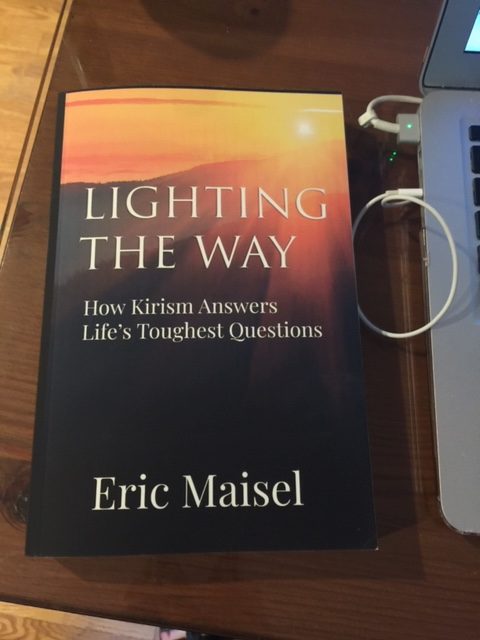
It may not have occurred to you that you were missing a philosophy of life or that you needed a philosophy of life. But having one that you can believe in, that genuinely helps you, that is contemporary and free of humbug, that passes on fairy tales, and that does the thing that past philosophies and religions haven’t managed to do—make sense—is really a great blessing. I believe that kirism can serve you that way. You can read more about it here every Saturday and you can enjoy the first twenty books of kirism in Lighting the Way: How Kirism Answers Life’s Toughest Questions.
It might change your life.
**
Purchase other books by Dr. Eric Maisel
—
Dr. Eric Maisel is the author of more than 50 books. His interests include creativity, the creative life, and the profession of creativity coaching, which he founded; issues of life purpose and meaning; mental health and critical psychology (also known as critical psychiatry and anti-psychiatry); and parenting in a “mental disorder” age.
Dr. Maisel’s most recent books include Unleashing the Artist Within (Dover, 2019), Helping Parents of Diagnosed, Distressed and Different Children (Routledge, 2019), A Writer’s Paris (Dover reprint, 2019), Helping Survivors of Authoritarian Parents, Siblings and Partners (Routledge, 2018), Ten Zen Seconds (Dover reprint, 2018), 60 Innovative Cognitive Strategies for the Bright, The Sensitive and the Creative (Routledge, 2018) and The Magic of Sleep Thinking (Dover reprint, 2018). Please see our Publications section for more information on Dr. Maisel’s books.
Dr. Maisel writes the “Rethinking Mental Health” blog for Psychology Today and is a regular contributor to Mad in America, where he founded and edited its parent resources section. Among his favorite things are leading Deep Writing workshops around the world (in places like Paris, London, Rome, Dublin, Prague, New York and San Francisco), working with individual creativity coaching clients, and producing interesting and useful programs (like his Life Purpose Boot Camp Self-Paced Instructor Training).
Dr. Maisel divides his time between Walnut Creek, California, where he lives, and Belmont, California, where he babysits his grandkids a lot.
To contact Dr. Maisel, please use our contact form.


.