


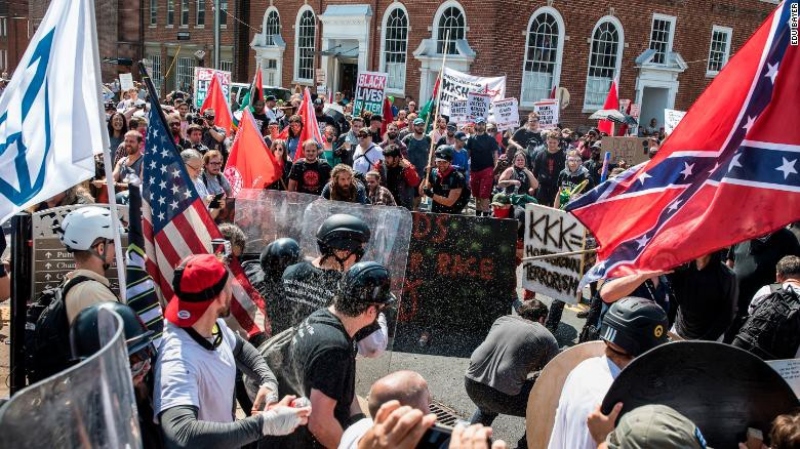
It has now been over three years since the tragic events in Charlottesville, Virginia, perpetrated by white supremacists and neo-Nazi groups. According to The Washington Post and other reputable sources, not enough has changed.
In interviews with The Washington Post, numerous Black residents and activists [in Charlottesville] echoed frustration. They said they are still pressing for change even as racial justice protests grip the rest of the country after George Floyd’s death in the custody of Minneapolis police May 25.
History Professor Elwood Watson, Ph.D. writes in his latest book, Keepin’ It Real: Essays on Race in Contemporary America:
It is a disappointing reality that many of the indignities (racial and otherwise), as well as differences in perceptions regarding the history and treatment of Black Americans ominously discussed during the 1960s, still apply today.
In addition to racism, anti-Semitism appears to have gotten worse under the failed leadership of racist-in-chief Donald Trump.
This is evidenced by the continuing re-emergence of hate groups fueled by the reckless rhetoric of Trump and his callous cronies. These demons of discourse only succeed by sowing more discord, division and discontent. They maliciously thrive on fomenting fear, tumult, and tribalism.
Deborah Levine, a consultant on diversity-equity-inclusion and editor-in-chief of the American Diversity Report, writes in her recent book (co-authored with Marc Brenman), When Hate Groups March Down Main Street; Engaging A Community Response:
Prejudice against Jews is ancient and has appeared at various times shaped by perceptions of religion, ethnicity, and race. Although Jews are a diverse ethno-religious group, biased critics often project on them a racial identity that has motivated intimidation and violence.
According to the Anti-Defamation League (ADL):
The ADL Survey of American Attitudes Toward Jews found that, over time, anti-Semitic attitudes have remained constant in America, with 11 percent of American adults – about 28 million people – harboring deeply ingrained anti-Semitic attitudes.
The ADL’s CEO, Jonathan A. Greenblatt, points out a disturbing reality:
In recent times, we’ve been horrified by an uptick in anti-Semitic violence. Our research finds that this uptick is being caused not by a change in attitudes among most Americans. Rather, more of the millions of Americans holding anti-Semitic views are feeling emboldened to act on their hate.
.
It's been three years since the violent, white supremacist #UniteTheRight rally in #Charlottesville. And we still don't have comprehensive #hatecrime reporting in every state. That’s why we continue to urge Congress to pass the #NoHateAct: https://t.co/bupoCsB9KK
— ADL (@ADL) August 12, 2020
***
Painful Reminder
As a white male, I can never fully comprehend the pain and anguish African Americans have experienced throughout history due to persistent racial injustice, blatant bigotry, and egregious race discrimination. However, as a Jewish American, recent events of social injustice still remind me of my first direct encounter with anti-Semitism as a teenager. I was working one summer on the loading dock of a hardware store carrying inventory off 18-wheeler trucks in 90 degree-plus heat. A white non-Jewish coworker in his early 20s had just experienced a bad breakup with his girlfriend. She left him in a deep state of remorse. He was an angry and bitter bully who was ready to lash out.
I quickly became his verbal punching bag via religious harassment based on my Jewish faith. He would say things to me like: “Hitler should have taken care of you kikes” and “Shut up or I’ll send you to the gas chamber.” This was quite shocking to a young person growing up in a predominantly Jewish small town on Long Island, New York. But it goes to show that, like racism and sexism, anti-Semitism has no geographic or moral boundaries.
Although my family was not particularly observant, my last name was all the biased co-worker needed to know to target his rage against me based on my religion. My family belonged to a synagogue that practiced reform Judaism. This is a form of Jewish worship and rituals aimed at adapting to societal modernism, as compared to Orthodox or Conservative Jewish sects which practice stricter religious observance.
Even though my family belonged to the least observant sect of Judaism, those unprovoked anti-Semitic attacks so many summers ago still sting. Perhaps I should have retaliated by hitting the bigot over the head with a crowbar or large piece of lumber. Regardless, I refrained from stooping to his low level.
Instead, I took a deliberate stand on higher ground based on peaceful resistance. I turned the other cheek and ignored the taunts by walking away, rather than reacting to hate speech with violence. I verbally protested to our supervisor about the hate speech, which stopped shortly thereafter. Those old memories are particularly painful during these turbulent times of racial division, injustice, and upheaval shamelessly promoted by President Trump, the divider-in-chief.
I recall the wise words of Dr. Martin Luther King Jr., who referred to non-violence as “a sword that heals.” He said:
Nonviolence is a powerful and just weapon which cuts without wounding and ennobles the man who wields it.
There are plenty of ways to effectively counteract hate speech and discrimination by peaceful means. The Black Lives Matter movement has proven this by holding marches and protests nationwide based on the noble principles of civil disobedience.
.
SPEAK UP.
SHOW STRENGTH.
SHARE FACTS.
This fall, don’t sit idly by as hate continues to flourish. Join ADL's virtual events where your voice will be heard and you can make a difference in fighting antisemitism, extremism, racism and hate of all kinds.https://t.co/nKMrkum5PZ
— ADL (@ADL) August 13, 2020
.
Final Thoughts
Today, in the aftermath of the death of beloved Congressman John Lewis, I’m reminded that hate and violence too often beget hate and violence. That’s why civil disobedience is the correct course to pursue.
That’s because once the vicious cycle of violence starts, it’s not always easy to end, and there’s no telling what levels of devastation and despair may result when each side retaliates with aggression.
Dr. King, John Lewis, and other civil rights leaders of the 1960s persevered in testing the nation’s conscience about racism, bias, and bigotry. Their unwavering discipline and fortitude through strict adherence to non-violence are why minds were changed and historic progress was made by the landmark Civil Rights Act of 1964 and the Voting Rights Act of 1965.
In the words of MLK:
Darkness cannot drive out darkness; only light can do that. Hate cannot drive out hate; only love can do that.
Three years after the horrific tragedy of Charlottesville, these are critically important lessons by which to abide in the pursuit of social justice and racial equality for all people.
—
A version of this article was previously published on Medium.com
***

If you believe in the work we are doing here at The Good Men Project and want to join our calls on a regular basis, please join us as a Premium Member, today.
All Premium Members get to view The Good Men Project with NO ADS.
Need more info? A complete list of benefits is here.
Talk to you soon.
—
Photo credit: EDU BAYER


.