


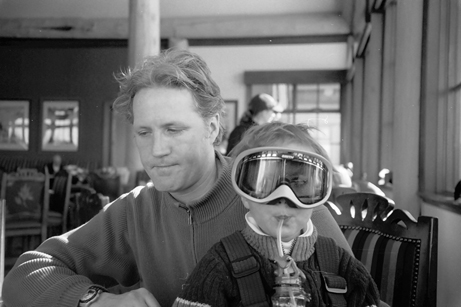
When Michael FitzGerald lost his job, he didn’t tell his kids. But they knew something was fishy.
The other software developer and I followed the HR woman in and sat down. Our boss was behind his desk, red-faced and unblinking. I thought we were in trouble for less-than-discretionary web surfing. Instead he told us he liked us, but that the company was being forced to make some cuts. Our last day would be in one week.
As I was riding my bike home that day, what I felt more than anything was this: I have failed my 6 and 3-year-olds. I have put them in harm’s way. I am a bad dad. I’m in a position to be laid off because I’m an unserious person. I dabbled in writing rather than fully committing to my software engineering career. Get off this bike and apply to the CS program at MSU, I told myself. Finish the application before this weekend.
But I didn’t do any of that. In the evenings, for that first week, I gave myself little pep talks, like, “No beer until I have a job.” Then I drank ten. I stopped eating and, after averaging forty miles a week in preparation for the Missoula Marathon, stopped running. At the Saturday Market, my 3-year-old asked for a $2 cannoli, a treat I’ve bought him every time we’ve gone since he could speak, and I almost bit his head off.
And, although it wasn’t really a decision, I didn’t tell the kids about losing my job.
♦♦♦
Prior to their arrival, if I thought about children at all, I saw them as an interesting accessory. A young boy launching off a park bench on his skateboard might suggest he learned this trick from some older wiser skateboarder. A ridiculously cute little girl—are there any other kind?—would highlight some fanciness to my genes. It never really occurred to me they were small people in need of food, coats, love, and endless summer camp tuition.
But then they arrive, and within hours of getting them home from the hospital, it’s clear we should have been thinking differently. Everything has changed, right? One thing is over and another has begun. Sleep becomes an exotic luxury. Lounging on the couch with a magazine becomes an indulgence, one likely to bring out the wrath of your even more exhausted wife.
Children blow us back to the Stone Ages. The world becomes sticky and sleep-deprived and reeking of Enfamil. All our goals become elemental: keep the child warm, fed, and relatively clean. Within hours we see so much of our previous life as frivolous and petty.
Now every waking moment is about life and death. Every decision fraught with the possibility of irrevocably screwing the child up. Every time you sneak off to pee, you make a calculated gamble about whether they’ll pull the tv on themselves as you flush.
We crumble before them.
♦♦♦
After they got here, I furiously re-prioritized. I made an offer on a house we couldn’t afford, started a 401K, bought a $400 baby jogger. A hobby, computer programming, which we considered a joke that supported my wife and I while we wrote novels, suddenly became an incredibly attractive career. I no longer thought of myself as a writer. I was a “software engineer.” A software engineer who buys shit for his kids. Overnight, I became the cliché my father had been suggesting all along.
Then the second child, and it was like watching doors rust shut. Everything was officially over. No more writing. No more traveling. Go to work and earn college tuitions, repeat, forever.
But fortunately that doesn’t last forever. We come out the other end. They get out of diapers. Our lives are infinitely richer. In fact, life becomes more punk rock than ever. You do everything you were doing before but you do it without having slept.
You do it broke. You do it with mac and cheese in your hair. You do it with little barf stains on your shoulders. People without kids suddenly look like amateurs. Writing software (or a novel) is nothing compared to writing software with a 2-year-old jumping on you from the top of a couch covered in peach yogurt.
♦♦♦
Going on a month, the 6-year-old knew something was up. I was doing contract work from home. And although money was coming in, my ability to say where I worked or what I actually did wasn’t particularly firm.
One of Missoula’s weathermen is the father of his kindergarten classmate. The kids all know what their dads do. Although I’ve supported us through software programming, I was an “author” when I came in to visit the class one day. (Outside the class, in the grown-up world, I’d published a novel to small acclaim. The total income for the book equaled about two months of salary from my software job.)
When my wife and I would talk about money or jobs during this month, the 6-year-old would quiet. Then one day, he asked, “Dad, don’t you work at P—- any more?”
“It’s complicated. I sort of work all over now.”
“You mean you’re writing more books?”
“I’m trying but it takes a while,” I said. “To be honest, I’m not really sure what I’m doing. But you don’t need to worry about it. Everything is going to be fine.”
He looked at me, puzzled, but probably thinking that when I talk like this, everything is probably not fine.
♦♦♦
Why, exactly, is me losing my job a direct affront to their lives? Plates shift in our being. We’re physiologically different than before. Someone sneaks in and replaces our kidneys with ones that don’t work while they and their welfare aren’t being thought of constantly. Self-destruction used to be delicious and fun; it was how we found our edges. Now, it’s simply selfish and thoughtless. And when we do it in a way that affects our kids, we feel it in every molecule.
♦♦♦
Things eventually worked out. Job offers trickled in and a small start-up I co-founded began gathering steam. Then one night, right before I accepted one of the offers, the 6 year-old and I were eating ice-cream on the porch. He wanted to go to the river the next day and I told him I couldn’t because I had a job interview. He asked what that meant.
I told him I was speaking to someone about working for them. “Why don’t you work for P— anymore?” he wanted to know.
“They ran out of the kind of work that I do,” I told him. I paused trying to gather my thoughts on how to explain it all to him. I looked over and he was licking the bowl.
“That’s cool,” he said after it was clean. “Is the new job a better job?”
“I don’t know,” I said. “Maybe.”
“That’d be great if it was, huh?”
“Yeah,” I said. “That’d be nice.”
I kept it from him because of shame and my own insecurities, but he could care less. Their trust and admiration runs deep and wide. Summer camp is nice, but even if things are a mess, they just need to go to bed each night with a little ice cream inside them and dream their dreams.
And later, in my own bed, I think, I am not them. Before they came, I was a projected image on the wall of a well-lit room. Then darkness fell and I became clear and bright and there was exhaustion and fury but also clarity and purpose: them.
—
A version of this essay previously appeared in the print version of Mamalode, Issue #2 Winter 2009. (http://www.mamalode.com)
—
TRENDING POSTS
-
The Consequences of Normalizing Hate Speech
-
Detoxing Culture & Healthy Masculinity
-
Proposing Marriage: Before and After
-
Why Are so Many Successful Men Miserable?
Don’t like ads? Become a supporter and enjoy The Good Men Project ad free -
Go North, Young Man. And Woman.
-
10 Adorable Compliments That Will Melt Her Heart
-
Have We Forgotten Our Mortality?
-
To The Man Feeling Too Guilty to Leave
-
Where Have All the Consumers Gone?
—
What’s your take on what you just read? Comment below or write a response and submit to us your own point of view or reaction here at the red box, below, which links to our submissions portal.

◊♦◊
Get the best stories from The Good Men Project delivered straight to your inbox, here.
◊♦◊
Sign up for our Writing Prompts email to receive writing inspiration in your inbox twice per week.


.
Hey Tom,
Thanks so much. I saw the Gray documentary years ago and remember thinking the whole time.. and he gets paid?
But yeah, getting a little loose on the sentence level is the most fun and gratifying, but always the hardest to get past the editors. I’m grateful to the GMP staff for letting this piece get as far as it did.
Thanks again.
Sincerely,
Michael
Dear Michael
I appreciate your heartfelt and well-written story. I just saw the documentary that Steven Soderbergh made about Spaulding Gray, who described his work as poetic journalism. That’s what I would call your story.
Best,
Tom