


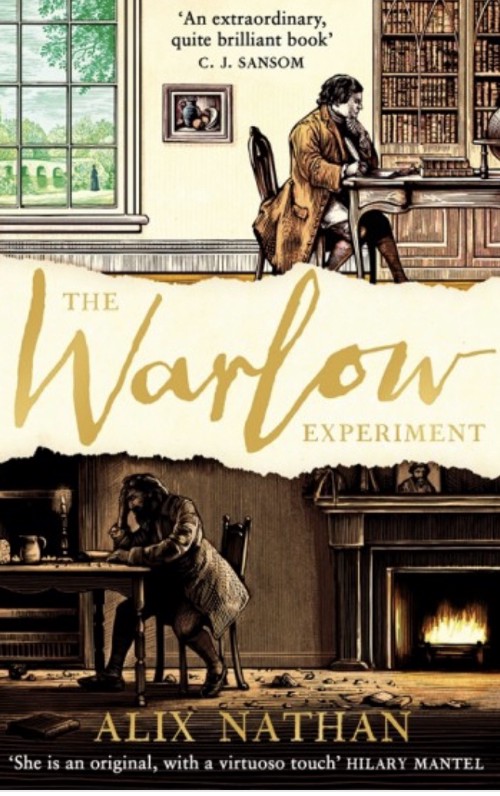
Amid a raging pandemic marked by unparalleled levels of isolation, it’s hard not to feel like the universe or its master is testing us — that earthlings are nothing more (or less) than bacteria in a petri-dish, to be manipulated for purposes beyond us by something above us.
Fittingly, this surreal year’s most pertinent novel is also its strangest, with bountiful implications for life during — and after — COVID-19.
Alix Nathan’s The Warlow Experiment describes an eighteenth-century scientist’s exploration of the human capacity for social isolation. Imagine freeing someone from the need to work and surrounding him instead with fine wine, fine books, and fine food. Will the human who emerges at the other end be self-actualized, something more than human? Or, bereft of others with which to make sense of his life, will he become less than human — animal, even?
First, a spoiler-free synopsis: The wealthy and quirky Herbert Powyss lives in a Welsh mansion, one affording him bountiful resources to whither away in frivolous aristocratic pursuits. But, not atypical for an aristocrat in the Age of Enlightenment, he longs to make a mark. His great dream? To present something consequential to the Royal Society in London — a scientific contribution fit to render “Herbert Powyss” a bold term in a history book.
Powyss eventually hits on a radical experiment — one meant to test the human spirit, especially its capacity for isolation. What is the boundary, the introverted amateur scientist asks, between loneliness (bad) and solitude (good)?
The experimental design is horrid yet simple. For seven years a subject shall inhabit suites in his manor’s basement, fitted out with rugs, books, paintings, and even a chamber organ. Sumptuous meals will arrive thrice daily via a trapdoor. The solitude will be unrelieved by social contact, and to aid Powyss in his research, the subject will keep a detailed diary of his thoughts, emotions, and actions. The compensation: fifty pounds a year — for life.
Although this is chump change for the wealthy Powyss, it’s a life of riches for an average Welshman. (This raises questions of experimental ethics. Given the economic incentives that would likely render a volunteer’s willingness to participate voluntary in name only, ethics boards would probably say no to Powyss’s experiment.) Whatever the case, Powyss soon has an applicant on his hands, a functionally illiterate laborer with a wife and six children by the name of John Warlow.
Unfortunately, the experiment — not unlike COVID-19 — has unforeseen consequences for all.
Largely, what glued me to the novel is the striking manner in which Powyss’s experiment on Warlow mirrors God or the universe’s experiment — through COVID-19 — on humanity.
Both The Warlow Experiment and COVID-19 seem to highlight fundamentals truths of human nature:
(1) Any human life has meaning only in relation to other human lives. As Aristotle knew, we are social animals. While momentary aloneness can provide a sense solitude, extended aloneness soon becomes loneliness and — as the 2020 pandemic teaches — clinical depression.
(2) Our need for romantic intimacy is greater than our need to remain alive. While Warlow suffers immensely from the lack of intimacy, Powyss — brought into contact with women due to Warlow’s confinement (I won’t say how) — soon finds himself entering a relationship with dangerous implications. Similarly, dating has not stopped because of COVID-19. Love finds a way.
(3) The hyper-educated rich often have very little understanding of the lives of the less educated poor, and this deficiency can cause cruelty and exploitation. At first, Powyss seems to think Warlow — who only signs up due to stifling poverty — should be grateful for the chance to become his prisoner. More, he seems to think that his hobbies — fine literature, fine music, and fine dining — should be enough for an illiterate man to weather seven years of isolation. This reminds one of the dysfunction that the disconnect between America’s rich and poor is producing during COVID-19. (For example, the skyrocketing stock market has little connection to the economic realities of most Americans, yet it unfortunately seems to lessen Congress’s urgency to provide aid to average Americans.)
I’ve spoken with many friends as late who are bored, lonely, or both. Novels can rectify that — especially novels that deal with as many relevant themes as The Warlow Experiment.
Do yourself a favor and give the book a read.
—
Previously Published on Medium
—


.