


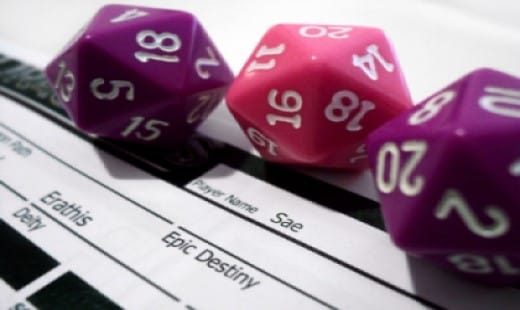
My brother was a Dungeons and Dragons wizard. I don’t mean that literally—I mean, he played for so long, his character was basically a god, and he’d probably be offended if I called him a wizard—but he knew his stuff. He was a Dungeon Master, and for years he tried to get me to play. He’d beg me to come down to the cellar (yes, he played in a dungeon) with his friends and join in, or at least roll the dice and choose my character traits.
But I couldn’t grasp it—I’m an intensely visual person. If I don’t see it, it can be difficult for me to imagine where things line up in space (this could be due to my complete lack of depth perception and my own spatial issues.) Every time we sat down to play, all I could see were rolling dice and papers. Nothing to excite my imagination.
So when my son, who has a non-verbal learning disorder (NVLD) asked if he could go play Dungeons and Dragons with his friends, I was hesitant at first. I wanted to let him go, but I foresaw the problems that come with differing social skills. I thought if I had a hard time understanding this game, how could he do better? Kids with NVLD have such sensitive self-esteem, and I worried he’d come home disillusioned and feeling dumb.
I was dead wrong. He had a great time, and enjoyed the game so much he asked to go again, something new for my socially struggling teen. It wasn’t until the third time he asked to go to a friend’s house to play that I came across some valuable information about NVLD that explained how well he did and why he loved the game I couldn’t grasp so much.
Non-verbal learning disorders can make visual learning difficult for children. But it doesn’t mean the other senses suffer the same way. Dungeons and Dragons, as the Dungeon Master gives verbal cues or tells the participants the main story, becomes an auditory game, and children with NVLD excel at learning through auditory means. They have excellent recall as long as they learn in an auditory fashion. As the Dungeon Master gave a coded message during the game, my son figured it out quickly, because his particular brain heard the message and correlated numbers and letters. His self-esteem buoyed, and the instant gratification of doing well on something gave him the confidence to continue playing.
But NVLD kids often don’t have the same skills and strengths of a neurotypical child. It isn’t that they lack the ability to do the task, but rather that they need to learn it in a way that makes sense to them. They often think out of the box, and come up with unique answers to problems–if only we let them.
What that meant is that my son learns differently than I do, and once I realized it was the auditory learning that allowed him to thrive during the game, I remembered the tests he does really well on. The ones where we make up silly sentences using the names for continents or countries, or remember science facts by putting them in iambic pentameter. Now I understood the reason he did so well on them—because we changed the method of studying to a format he could absorb. That revelation translated from having fun playing Dungeons and Dragons to getting an A on his French midterms.
As an educator, I always promoted teaching to each child—finding their strengths and building on them, and working to fortify skills they were still working on.
But NVLD kids often don’t have the same skills and strengths of a neurotypical child. It isn’t that they lack the ability to do the task, but rather that they need to learn it in a way that makes sense to them. They often think out of the box, and come up with unique answers to problems–if only we let them.
We need to remember–and encourage our children’s teachers to remember–that non-verbal learning disorders, like any neurodiversity, is not an illness or something to be cured; it’s simply a different way of thinking. If we can find the strengths in that, we can help our children have a much more successful academic career. And if we can then teach to each child, as opposed to a one-size-fits-all approach, we may be able to tap into a whole new world of creative thinking.
—
***
What’s Next? Talk with others. Take action.
We are proud of our SOCIAL INTEREST GROUPS—WEEKLY PHONE CALLS to discuss, gain insights, build communities— and help solve some of the most difficult challenges the world has today. Calls are for Members Only (although you can join the first call for free). Not yet a member of The Good Men Project? Join below!
RSVP for Intersectionality Calls
—
 Join the Conscious Intersectionality FACEBOOK GROUP here. Includes our new call series on Human Rights.

Join The Good Men Project Community
All levels get to view The Good Men Project site AD-FREE. The $50 Platinum Level is an ALL-ACCESS PASS—join as many groups and classes as you want for the entire year. The $25 Gold Level gives you access to any ONE Social Interest Group and ONE Class–and other benefits listed below the form. Or…for $12, join as a Bronze Member and support our mission, and have a great ad-free viewing experience.
Register New Account
Please note: If you are already a writer/contributor at The Good Men Project, log in here before registering. (Request new password if needed).
◊♦◊
ANNUAL PLATINUM membership ($50 per year) includes:
1. AN ALL ACCESS PASS — Join ANY and ALL of our weekly calls, Social Interest Groups, classes, workshops and private Facebook groups. We have at least one group phone call or online class every day of the week.
2. See the website with no ads when logged in!
3. MEMBER commenting badge.
***
ANNUAL GOLD membership ($25 per year) includes all the benefits above — but only ONE Weekly Social Interest Group and ONE class.
***
ANNUAL BRONZE membership ($12 per year) is great if you are not ready to join the full conversation but want to support our mission anyway. You’ll still get a BRONZE commenting badge, and you can pop into any of our weekly Friday Calls with the Publisher when you have time. This is for people who believe—like we do—that this conversation about men and changing roles and goodness in the 21st century is one of the most important conversations you can have today.
♦◊♦
We have pioneered the largest worldwide conversation about what it means to be a good man in the 21st century. Your support of our work is inspiring and invaluable.
Photo credit: saeloveart on Pixabay.


.